
Our Most Effective Jev Use Case: Walking Agent Memory
Everyone is posting their best Jev use case. Here is ours.
The problem
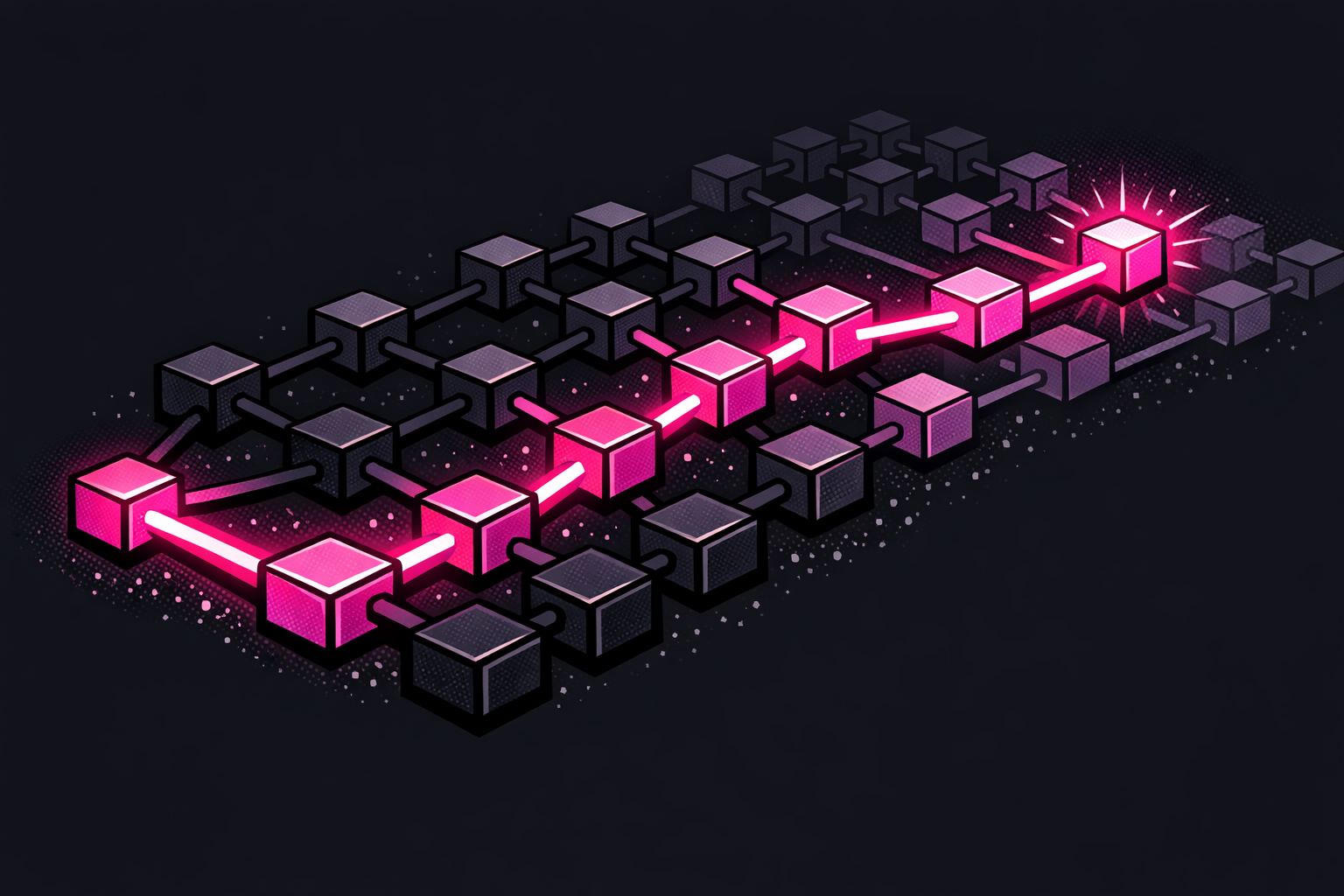
Our assistant remembers long conversations as a knowledge graph — facts extracted from each section of the conversation, linked through the people, projects and files they mention. Before every turn, recall injects the facts most likely to matter.
Recall was a hybrid search: keyword match, vector match, and a blind one-hop grab of neighbors, merged by list position. It works when the question uses the answer's words. It fails on the questions that matter most in a long working session: follow-ups that refer back to earlier work. Their subject lives one turn back, or one hop away, and nothing in the search judges which path leads there.
The walk
Every step of a graph walk is a small typed decision, which is exactly what Jev returns.
- Per fact, a noul: does this fact relate to or support the latest message, read in light of the recent conversation? Facts above 0.5 lead on to their neighbors; facts above 0.7 are kept.
- Per level, one more noul: do the facts in hand contain the answer? Yes ends the walk.
- The graph read is speculative. While Jev judges a level, the next hop is already being read from the graph. If the answer is in hand, the read is thrown away; if not, it goes straight in front of the same question. The graph never adds a round trip.
- The message is read with its context. A follow-up that only refers back has no subject of its own, so every call carries an overlapping window of the dialogue before it — the same idea as overlapping chunks.
Everything in a level rides in one parallel fan-out, so breadth is nearly free and depth costs one round trip per level.
The results
We replayed 30 real turns where the answer depended on memory, against the graph exactly as it was at the time, and had a separate model grade each injection blind, on a 0–3 scale against what the assistant actually needed.
| Mean score (0–3) | Better than recall | Worse | |
|---|---|---|---|
| Hybrid recall | 0.95 | — | — |
| Jev walk | 1.53 | 22 of 30 | 5 |
| Jev walk + dialogue context | 1.78 | 23 of 30 | 3 |
Nearly double, while injecting 16 facts to recall's 8 with no more irrelevant ones. On turns where the assistant had once forgotten something and been corrected, the walk put the missing fact in front of it.
We also tried a last pass that asked Jev which kept facts conflict and dropped the older of each pair. It changed one turn in thirty — Graphiti already retires contradicted facts at ingest (450 of 1,577 in one conversation's graph) — so we dropped it.
What we learned
- Jev judges what you give it. Our first walk failed on follow-ups not because Jev was wrong, but because a message that only refers back contains nothing to be relevant to. Context fixed it.
- Bridges score lower than answers. The fact that leads to the answer is often less relevant than the answer itself. Separate bars for follow and keep let a weak bridge lead on without being injected.
- Judging level by level beats judging everything at once. Reading all three levels first and judging every fact in one round was about 3× faster, but scored lower (1.63 vs 1.73 in the same grading run): facts judged alongside what's already been found are judged better.
- Measure without leakage. Replaying against today's graph lets facts written after the turn leak back in. Filter to what existed then, or the numbers lie.
Others walking graphs with Jev
The walk now serves recall in production. What's your most effective Jev use case?
Sources
- TypeSafe AI — Introducing System One Models and Jev: https://typesafe.ai/blog/introducing-system-one-models-and-jev
- Jiang, Li, Li — Jev-Mem: System-One-Controlled Agentic Memory for Efficient AI Agents (arXiv 2609.23986): https://arxiv.org/abs/2609.23986
- Michael Hunger — Navigating a Neo4j Knowledge Graph with Jev: https://neo4j.com/blog/genai/navigating-a-neo4j-knowledge-graph-with-jev/
- Governed Agent Memory with Structured Judgment: An AtMem–Jev Retrieval Study: https://huggingface.co/blog/javadtaghia/an-atmem-and-jev-experiment-can-a-judgment-model-h