Guides, use cases, and deep dives.
How teams use AI assistants to connect their business tools — plus deep dives on the architecture behind it.
Agentic Memory Architecture — Part 2
Jev extracts facts from any text by selecting sentences out of it: it marks where each fact begins and ends, checks the span, and keeps the words as written. Ranking the facts is a separate, optional step against whatever matters to you. We use it to compress an agent's context; the extraction itself works on any text.
Read article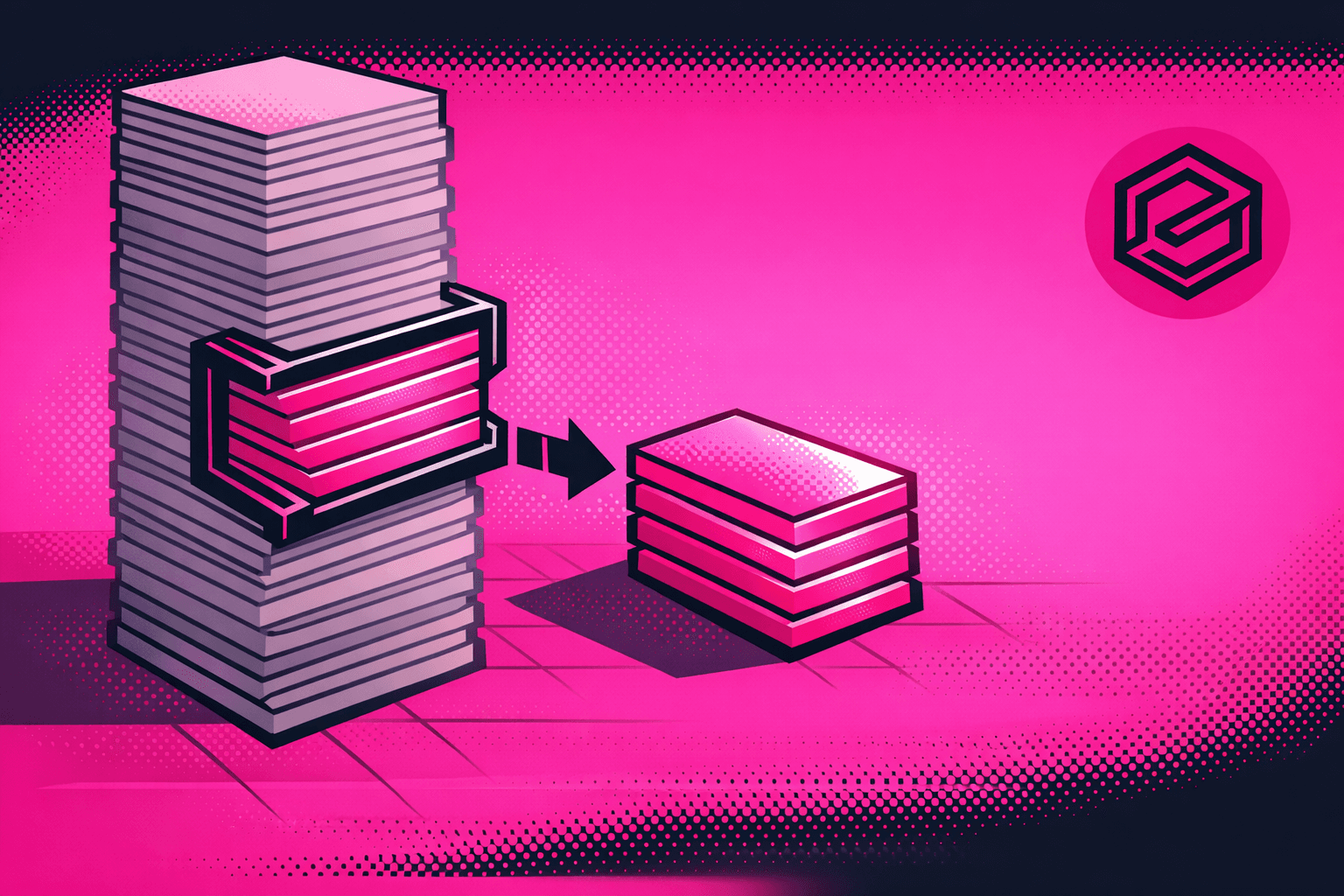
How to store each piece of an agent's history as 80% the piece and 20% its turn, split each query the same way, and search every part on its own. Built on an ordinary embedding API, with code, a controlled test, and results from 51 production threads.

We let Jev walk our agent's memory graph one level at a time — judging every fact, reading the next hop while it thinks, and stopping when the answer is in hand. Blind-graded on 30 real turns, it retrieved nearly twice as much of what the answer needed.
Jev, TypeSafe AI's System One model, does not generate text. You declare a return type and it returns a typed decision — Choice, Noul, or Score — with calibrated confidence, fast and cheap enough to sit inline in code.
Claude Cowork, ChatGPT Work, and Kazi Cowork overlap heavily on task execution. The real difference is what surrounds the work agent: an enduring chief of staff, durable threads, delegated agents, and playbooks that turn learned processes into personal software.
Defensive system prompts ban tools and hope for the best. The better move is writing instructions that make the desired action the natural conclusion of the model's own reasoning — right when it's choosing what to do next.
A voice-enabled AI technical project manager that joins your standups, retrieves context from Jira, Linear, and Confluence, and creates tickets with assignments before the call ends. Not a notetaker — a TPM.
Two paths to recurring automation — live agent workflows that reason every iteration, and compiled skills that run deterministically on a cron. Both connect through one MCP surface. The easiest way to agentify CI/CD and internal tooling for engineering teams.
A summary is a mid-step, not an outcome. Real agentic solutions take action during and after the meeting — creating tickets, scheduling follow-ups, messaging owners, and closing loops without handing the work back to a human.
Most AI note takers record, transcribe, and summarize meetings. See how an AI meeting assistant can take actions, update systems, and turn meetings into outcomes.
73% of employees use unsanctioned AI tools. Most enterprise AI adoption is organized chaos — different tools, no audit trail, no delegated auth. Here's how a purpose-built AI co work bridges that gap: one execution layer, one MCP server, and IT-controlled delegated auth.
A fact-based guide to AI video tools for product demos, walkthroughs, and marketing videos. Where each tool fits, what it actually does, and why the editing layer — not just generation — changes the workflow.
A required enum on your tool schema forces verification at the exact moment of decision. Apply sparingly, make it dynamic, and you have precise behavioral control without a bloated system prompt.
Agents forget mid-task. The fix isn't a dedicated memory tool—it's decorating every tool schema with a task_scratchpad parameter. Each tool call becomes a structured extraction, and chat history becomes the scratchpad.
Every coordination meeting generates hours of Procore data entry. Connect your Fireflies transcripts to Procore and let AI turn action items into tasks, RFIs, and submittals automatically—no manual entry.
Stripe batches fees, refunds, and timing adjustments into one deposit. QuickBooks sees one number. LedgerBot explains the gap in plain English and shows you exactly what to fix—no spreadsheets required.
The Recursive Language Model (RLM) pattern explains the missing piece in most AI agents: real code execution. Here's the production infrastructure that makes agents reliable—progressive discovery, sandboxed execution, and persistent skills.
General-purpose AI tries to do everything and often fails at the things that matter. Task-specific agents—each scoped to one API and one job—are faster, more reliable, and easier to debug. Here's the architecture.
If you've managed engineering across multiple product teams, you've seen this pattern: a product manager requests a simple notification—"Can we notify Slack when a high-priority Jira ticket is created
In the world of AI agents, there is a massive gap between "writing code that works" and "building a reliable system." Most agentic frameworks treat code execution as a disposable event. An agent write
The dream of "Agency as a Service" often hits a wall: the real world isn't fully API-fied. Whether it's a legacy government portal, a proprietary internal tool, or a site that hides its data behind a
Here's what most people get wrong about AI in business software: they think it's either "automate everything" or "do nothing."